Showing posts with label Caleb Wilde. Show all posts

Tuesday, July 23, 2013

Confessions of a Funeral Director -- Writing the Dark Chapters

CONFESSIONS OF A FUNERAL DIRECTOR
Writing the Dark Chapters


By Caleb Wilde

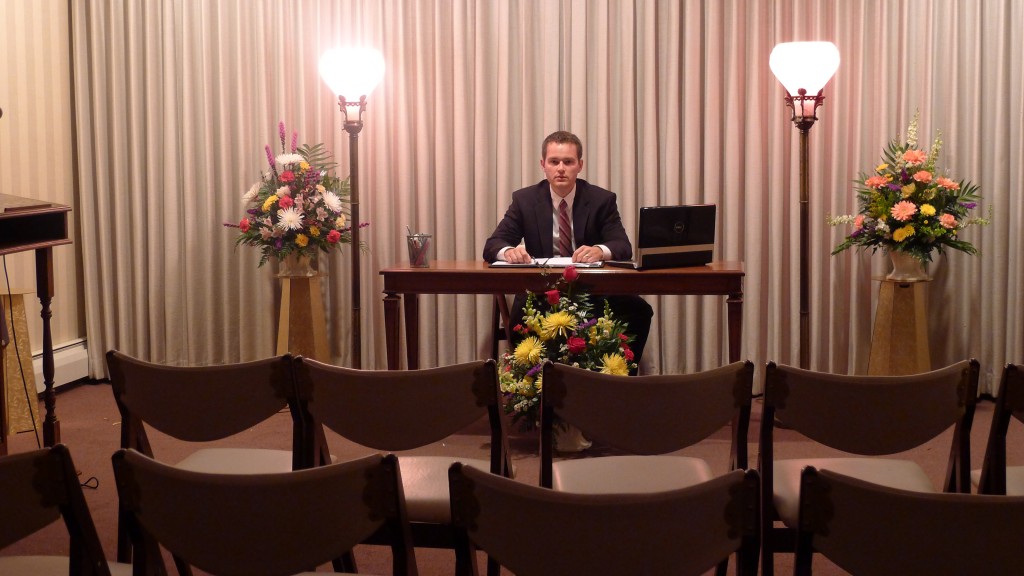
I walk into a room at 6 a.m. and all eyes fix on me and my next move.  I am, after all, the odd one out in the room, the one whose face isn’t stained with tears; the one wearing dress clothes, who’s there in body, but whose soul isn’t in the depths.

I’m the colonialist, walking into another culture, ready to impose society’s desire for a clean picture of death.

Those who are sitting around the bed of the deceased aren’t thinking about what you and I are thinking about at 6 in the morning.  They aren’t wondering how they will get their kids dressed in time for school; or how they’re going to pitch their project to coworkers at work.

Everything is on hold.

Time has slowed at a pedestrian pace and they sit in grief … resisting the reality that what was their husband, their wife, their son, daughter, grandfather, friend is no longer present to hug, laugh and live with.

Death creates its own culture … its own world.

A world where time seems to altogether stop, where language is often spoken with less words and more tears, hugs and contemplation, where the regular dress code doesn’t exist and where the norms and mores of society are put on hold.  Here, in this sacred space at 6 a.m. in the morning, God seems nearer; family and friends surround you; you can let your emotional inhibitions go.  This is the world that was never meant to be and yet is everything you wish it could be.  It seems we have to go back through death to get to Eden.

With tie draped down my dress shirt, if I can’t imagine a world unlike mine … if I can’t picture a context outside of me … if I can’t remove myself from the all too obvious facts that it’s 6 a.m., I’m tired, didn’t get my Dunkin Donuts medium coffee with cream and sugar, and that I’ll be even more tired tonight when I’m supposed to go to Chili’s with my wife; if I can’t imagine the family’s story; the story of the deceased and his life and the loss this represents, I can’t be a good funeral director.

Funeral directing is a lot like writing.  It involves alterity, imagination and the ability to make a lot of the detail and little of the obvious.  I write the story as I walk into the sacred space of grief.

I notice the one closest to the decease’s body.  ”That’s probably the NOK”, I think to myself.  Granted, the story is easier to imagine if I already know the family, but this morning I don’t.  The closest one to the bed is oft the main character in this play; and I can write a story of comfort, by entering the narrative with a warm hug, maybe even a kiss, a kind smile and eyes that speak of the compassion my heart is feeling; or, I could write a story as a narrator, standing back, observing and not entering.  What does this specific family need?

I wait as the drama unfolds, as my very presence evokes the supporting characters who will inevitably point me to the protagonist.


Asking questions; feeling out the room.  I enter in and I – at this very moment – have the privilege and responsibility of helping to write this chapter.

Taken from 

Friday, July 12, 2013

 Filming My Own Eulogy
 by Caleb Wilde of Confessions of a Funeral Director
Caleb Wilde

Jerry Seinfeld is quoted as saying that the two greatest fears for humans are public speaking and death.  Being the machismo embodiment of masculinity that I am, I’ve always wanted to conquer both fears at the same time.   And there’s only one way to do it: speak at your own funeral.

This ultimate act of bravery is now made possible through the advancements of 21st Century technology.  We can actually film our last words.  And we can do more than film our last words.  With internet sites like “My Own Eulogy”, you can not only film your eulogy, but build a 21st Century “memorial site” … a library of videos to be shared with loved ones when you pass.

I saw a part of the movie “Get Low” last night which tells the tale of a man who knew he was going to die so he wanted to have his funeral service before he breathed his last.  It’s a great idea that few of us could accomplish even if we wanted to because we simply don’t know know our death date (would you want to know it?).

I’ve planned that each year I’d record a brief video of myself, where I briefly state what happened this past year, what major events occurred, etc.  If I starting doing it now, and create a new one each year, I could then have somebody cut up each video and make it into a brief bio video timeline that could be played at my funeral … as my eulogy. There could be like a 20 second clip from each year and you could see the progression of my aging as the years role by.

“If I Die” just developed a Facebook app that allows you to send out posthumous Facebook messages/videos/updates to friends and family.

And I’m sure as all these ghost Facebook pages accumulate, Facebook will eventually find a way to create a memorial section … a Facebook grave site or sorts.

For the most part, the funeral industry is about 10 to 20 years behind the rest of the world simply because we service the oldest generation.  But within the next 10 to 20 years, I image we will see more and more innovative sites like “My Own Eulogy” (MOE is ahead of the curve) that allow us to speak from the grave.

Here’s my first attempt to “record my own eulogy” that I made for “My Own Eulogy”‘s website.  It was all extemporaneous and I went over the recommended time limit of three minutes.  But, it was a decent first try.


It was definitely hard … it was hard trying to think of words that you’d want to live forever.  My forever words for my family and friends.   And, it was mainly hard because I’ve yet to meet my children, so I’m not really sure what “forever words” I should say to them.

And, I might add, this is kind of a vulnerable video, so if you’re feeling snarky today or you’re just trolling, please resist the temptation to point out my receding hair line or my knack for fumbling for words … or the fact that my nostrils flare when I’m trying to be serious.

View his video here:


So now that you’ve seen the video that I posted (or as much of mine as you could handle, or your lunch time would allow), head on over to “My Own Eulogy” and record your own.  And be sure to check out Alba’s eulogy … it’s pretty cool!

What would you want to say in your eulogy?  What would be your “forever words”?

Thanks Caleb for sharing!
Article borrowed from


Dying Well

5 Tips for Creating a Personal Sendoff

Today’s guest post is from Elizabeth Meyer.  Elizabeth is an expert in planning personalized funeral services, and hopes to make funeral planning a less taboo, more approachable subject. After planning a unique funeral for her own father in 2006, she joined Frank E. Campbell funeral home in New York City as Family Services Liaison, where she served Campbell’s and Riverside Memorial Chapel helping families create exceptional services. She earned an MBA from Cass Business School in London and a BA from New York University. She is currently the Funeral Guru at Everplans.com.

When I tell people that I work in the funeral industry, most become speechless. Looking at me questioningly, they’ll mange to ask, “But…why?” I tell them about the funeral I planned for my father six years ago. It was the most emotionally challenging thing I’ve ever done, but it was also the most rewarding. I understand the power that a meaningful funeral or memorial service has in the emotional processing, grieving, and healing after a death. And so I use what I learned from my own experience to guide and empower others to create meaningful sendoffs for their loved ones. I deeply understand the power that a meaningful funeral or memorial service has in the emotional processing, grieving, and healing after a death.  I hope that by helping people create personalized services I am alleviating some pain for these families.

Obviously, I can’t tell you what specifically will be meaningful to you or loved ones. I can, however, share the lessons I learned from planning my dad’s funeral and the dozens of special funeral and memorial services I’ve helped other families plan. So without further ado, here are my top 5 things to consider when creating a personalized sendoff:

1. Religion


Religion is an important factor in funeral plans, and religious rites and traditions can dictate everything from whether the body should be buried or cremated, to where and when the service should be held, to what foods should be eaten afterward. If you’ll be following any religious rituals, get a sense of the traditions before you make any solid plans; the specific rituals you’ll follow may override any other desires you might have.

For example, you might want an ornate casket for your loved one and a lot of flowers at the service. But if you’ll be following Jewish customs, you’ll want to purchase a plain pine casket and forgo flowers, which are not traditional. Or, if you’ll be following Catholic customs, you’ll want to have people deliver eulogies and other speeches at a wake before the funeral service, since the service will be a Mass.

My father was raised Jewish, but was much more frequently found in church with my Catholic mother than in synagogue. While this meant that we were not constrained byto any religious norms at his funeral, it also meant that we were left custom-less, working with a blank canvas. If you’re like us, then the next four issues can be really important, since you’ll basically be traveling without a map.

2. Venue


When my father died, hundreds of friends wanted to support us; we needed a venue that could accommodate everyone. It was most practical to hold the funeral in the large non-denominational chapel at the funeral home. But we had other options, too: we could have held the funeral in a large church or synagogue, at an event space, or even a restaurant if we’d wanted.

Some funerals are quite large and others are very intimate; finding a venue that can cater to the number of guests is what matters most. (Remember: a funeral isn’t a popularity contest.) If you have a large number of guests, you’ll want to be able to fit everyone in the space. On the other hand, if there will be only a handful of guests, you’ll want to choose a smaller venue and create an intimate environment where everyone is comfortable.

So whether you choose a funeral home chapel, a church, mosque, or even your own living room, consider the number of people who will be in attendance, and think about where you’d be most comfortable remembering your loved one.

3. Music


When my father died in the prime of his life, my family and I were beyond distraught. But I didn’t want my dad’s funeral to be overwhelmingly morbid. Rather than concentrate on my family’s loss, I focused on making the event a celebration of my father’s incredible life. And one of the ways I made sure the funeral was a celebration was through music.

We had jazz playing as the guests entered. I chose songs that dad always played at home, and I was comforted listening to Miles Davis and feeling like he was there. At the end of the service, guests were caught off guard when Jefferson Airplane’s “White Rabbit” come blasting out of the speakers. By the time the Rolling Stones came on, everyone was dancing in the aisles as they wiped the tears from their eyes. Dad would have loved this!

Having a pianist or organ would not have been appropriate for my dad; he just wasn’t that kind of guy. But that doesn’t mean that it wouldn’t be perfect for your loved one. To figure out the right music for your situation, ask yourself: What were his or her favorite songs? What songs do you associate with him or her? What songs do you think he or she would like people to hear as they say goodbye? By choosing meaningful music you’ll feel like you are giving them a fitting sendoff—and it’s likely that the songs will elicit warm memories, too.

4. Speeches, Eulogies, and Readings


At my dad’s funeral, I selected speakers who knew my dad from different walks of life. My brother and I were the first speakers, and we shared our heartfelt and entertaining memories of our father. Dad’s cousin spoke about growing up with my dad; his, business partner spoke about what an amazing attorney and colleague my dad was; and a couple of friends also spoke about who he was as a man and a friend. By having all the speakers from different times and areas of his life, they were able to jointly create the most beautiful and complete image of my dad.

If possible, I would try to replicate have people deliver that same variety of speeches on a variety of topics.  In addition, No matter how entertaining the deceased was, repetitive stories are never fun! Also, it can be nice to consider incorporating readings into the service.  These can range from religious passages, hymns, and to poems from either the reader or the deceased favorite poets.

5. Flowers


I knew when I planned my dad’s funeral that flower choice was crucial. My dad was not particularly passionate about flowers—but flowers are so important to my mother, and I knew that she would be consoled by seeing flowers ones flowers that reminded her of dad.  So I opted for peonies, the flowers he always brought home to my mom.

Moreover, I opted to cover dad’s casket in a blanket of flowers. I knew it would be too difficult for my mom to walk in and see a casket at the front of the room; this way she was distracted and only saw her favorite flowers.

Flowers can remind us of the person we loved or distract us from our pain. Flowers can be in the colors of the person’s favorite sports team or in the shape of a heart, a cross, or even a golf club. They help set the mood, and they help make a funeral feel like a celebration.

These are my broad guidelines for creating a meaningful funeral. But please, get creative! Have a memorial service on a golf course or in a restaurant. Send ashes into outter space or out to sea. The only solid advice I can give is to honor the person who died with a fitting sendoff. I know it made me feel good about the final gift I gave my dad.

Article taken from:


Monday, June 3, 2013

Caleb Wilde: How to Speak the Language of Grief

HOW TO SPEAK THE LANGUAGE OF GRIEF
By Caleb Wilde

You walk into a house full of fresh grief.  It’s fresh because the death just occurred.  Your best friend’s husband went out to the bar last night, drowned his hard day in hard drink and he never made it back home.  Fresh.  Because both you and your friend have never experienced death this close.

You open the door like you have so many times before, but this time the familiarity of the house is unexpected different, dark and lonely.  What once housed parties, life and love now houses something you’ve never known before.  Like a river, everything is in the same place it was when you last saw it, but this home has changed.


You see your friend’s children sitting on the sofa, staring into space.

You ask them, “Where’s your mom?”

And as you reach to hug them, they snap back to reality and whisper, “Upstairs.”

Each step brings you closer to what you know is only an apparition of your friend.  The nerves build.  Fear begins to build.  You repress it as you ready yourself to meet your closest friend who has all of a sudden become someone you may no longer know.

“Can I come in?” you ask.  No response.

You push open the cracked bedroom door and see the body of your friend collapsed on her bed, with used tissues surrounding her like a moat.

You tip-toe into the room, slowly sit down on the bed, and not sure if she’s awake or asleep, you reach for your friends shoulder and begin rubbing her back.  Her blood shot eyes open, look at you and then, they slowly look through you.

You fill the weird silence with an “It’s going to be alright”.

“It’s not”, she whispers.  “I’m alone with two kids and no job.”  Her voice suddenly raises as anger courses through her body, “Why the f*** would he do this to me?”

The curse word chides you into recognizing that you’ve not only misspoken, but you’ve spoken too soon, so you decide to wait in silence.  She starts to cry.  You respond to her tears with your own.  Even though you want to respond with words, you know this isn’t the time for words.  There’s no perfection words here.  There’s no perfect anything here.  And so you wait.

You stay.  Listen.  Silence.  You take her pain into your soul.  Hours pass.  She rises out of bed and makes the children dinner.

You’ve spoken, not with words or advice; not by trying to solve the problem; nor by placing a limit on your time.  You’ve taken the uncomfortable silence, allow the grace for tears, for brokenness; you’ve allowed yourself to sit in the unrest without trying to fix it.

With your presence.  With your love.  In your honest acknowledgement of real loss, you’ve spoken the language of grief.

Although the language of grief is usually spoken in love, presence and time, sometimes it’s spoken in words.  And when it is, here are five practical “do”s and “don’ts”

The “DON’T”S:

1.       At least she lived a long life, many people die young

2.       He is in a better place

3.       She brought this on herself

4.       There is a reason for everything

5.       Aren’t you over him yet, he has been dead for awhile now


The “DO”S:

1.       I am so sorry for your loss.

2.       I wish I had the right words, just know I care.

3.       I don’t know how you feel, but I am here to help in anyway I can.

4.       You and your loved one will be in my thoughts and prayers.


5.       My favorite memory of your loved one is…


Caleb Wilde has many well written and insightful articles about death and dying... go to his website "Confessions of a Funeral Director" for more http://www.calebwilde.com/

Taken from 
http://www.leannepenny.com/2012/03/12/how-to-speak-the-language-of-grief/

Ritual: The Muscle Memory of Grief by Caleb Wilde

Ritual: The Muscle Memory of Grief
by Caleb Wilde

Caleb Wilde


Over the past couple months, I’ve been contemplating why the West (America, Europe, etc.) has so much aversion to death, while other — less “developed — cultures see death as less alien.  I’ve come up with two major reasons:


One.  Modernity.

Our modern world takes death care away from families and puts it in the hands of “professionals”, thus industrializing death.  Instead of the dying dwelling at our homes, we give them to nursing homes.  For more of my thoughts on this, here’s an article I wrote.

The modern world also likes providing answers to life’s questions.  So when death comes with its silence and mystery, we are rendered uncomfortable.

Two.  We lack ritual. There’s three reasons why there’s a lack of ritual:

1.)  We tend to be individualistic, which isn’t necessarily bad, but it produces a lack of community.

2).  We tend to dislike tradition.

3.)  We are becoming post-religious.

The following is my (rather poor) attempt to explain why the lack of ritual increases our aversion to death.

Muscle memory is what separates the professionals from the amateurs.

Muscle memory is what enables musicians to thoughtlessly play complicated music with near perfection.

Muscle memory is the product of laborious habit that makes incredibly difficult tasks seem like minutia.

I just came back from indoor rock climbing.

I’ve seen athletic and strong newbies come to the gym and they look like fools trying to climb routes.  Falling down on their bums, scraping their arms up and getting all nervous when they get to the top of the route.

Climbing is both strength and technique muscle memory.  And while newbies may be strong and athletic, if they don’t know how to move their bodies on the wall, they’re destined to fall and fail.

*****


Grief is similar. The walls of bereavement are very intimidating to even the spiritually and psychologically strong.  It doesn’t matter how whole you are, you will fall and you will fail.

Unless you enter through the trodden paths of ritual.

The muscle memory of grief is ritual. Ritual allows us to take the incredibly difficult task of mourning and find a way to persevere, even when it seems we shouldn’t.

Muscle memory is usually something you or I create through practice.  I climb routes at the climbing gym, my muscles get used to moving a certain way.

You practice the guitar day in and day out and your fingers move like jazz.

This is where the whole muscle memory analogy starts to fall apart when we relate it to grief.

While a professional’s muscle memory is something he or she created, death ritual muscle memory is something our community has created and it can only be “learned” within community.

You didn’t create it.  It’s something we inherit … or something we can join.

*****

This from Alla Bozarth in “Life Is Goodbye, Life is Hello: Grieving Well Through All Kinds of Loss”:

Funerals are the rituals we create to help us face the reality of death, to give us a way of expressing our response to that reality with other persons, and to protect us from the full impact of the meaning of death for ourselves.

The problem is this: so many of us have disconnected ourselves from community, tradition and a religion that we’ve never received the graces of grief ritual.

If we have community in place,

if we embrace tradition in times of death

and we’re willing to involve the motion and movement of religion,

we may find life and meaning in a task that many onlookers see as insurmountable.

Ritual doesn’t allow you to overcome grief (grief may never be overcome).  It doesn’t allow you to work through your grief faster.  Nor does make death more tolerable.  And it certainly won’t make you a “professional.”

Ritual allows you to confront a seemingly impossible task in the context of community.


Why is the West so adverse to death? Because devoid of ritual, confronting death is like asking me to play Beethoven’s Piano Sonata No. 23.


Mr. Wilde has many insightful articles that you may find helpful.
Check his website out Confessions of a Funeral Director

Wednesday, March 27, 2013

Ten Reasons We Are NOT Vulnerable with Each Other


Ten Reasons We Are NOT Vulnerable 
with Each Other

Article from: Caleb Wilde, CalebWilde.com

When we experience the death of a love one, it asks us to be willing to reach out to others, express ourselves and work through our grief with another.  Yet, few of us are willing to be vulnerable, to the detriment of our grief work … to the detriment of our relationships … to the detriment of our humanity.  The axiom is this: grief shared is grief diminished; grief repressed is grief magnified.

Here’s 10 reasons why we aren’t vulnerable:

One.  Vulnerable = needy.  Nobody wants to be seen as needy.  The image of a sniveling child, begging the help of their parent is so infantile.  We’ve grown out of that.  We’re adults.  We stand on our own.


But, vulnerability isn’t the same as neediness.  Vulnerability is a sign, not of dependence, but of a strength that bespeaks of our ability to be so confident in who we are that we’re willing to allow others to help define us.

Two.  Vulnerability means giving control to someone else.  Vulnerability is a giving of ourselves to someone else and allowing the response of the other to actually affect, change and/or hurt us.  If you’ve been hurt, if you’ve been abused and mistreated, vulnerability is next to impossible.  But, oddly, it’s when we’ve regained control and allowed ourselves to be vulnerable again that we know we’re beginning to move past our abuse.


Three.  This piggybacks off of number two.  Vulnerability means trusting that someone else will take that control and treat it gently and with respect.  By giving someone else control over you in your vulnerable state, you’re committing an act of trust.  We should choose wisely who we are vulnerable with.  Only those we trust.

Four.  Fear of being gossiped about.  “Did you see that post Caleb wrote on his blog last week?  He talked about suicide, leaving God and his wife.  He’s sooo … just sooo effed-up.”  And while we all appreciate concern, when we’re vulnerable and others see it, they will talk.  So be it.

Five.  Vulnerability can create misinterpretation.  It’s one thing to be talked about, it’s an entirely different thing to be misinterpreted.  Others will see it as weakness.  Other’s will see it as being needy.  Other’s will see this small chapter in your life and use that chapter to define your story.  “He’s so weak.  He’s messed up.”  Vulnerability isn’t weakness.  When done well, vulnerability is STRENGTH.

You can survive the gossip and misinterpretation because your story will shine brighter when this chapter is included.


Six:  Vulnerability is ungodlike.  At least that’s what we’re told.  In our pursuit to be like gods (and like God), we assume that we have to always be in control, always in control of our emotions; we might find that we’re trying to be like a god that doesn’t exist.  It would seem that God is weak, that God shows emotions … that God bleeds.

Seven.  Vulnerability doesn’t equal masculinity.   Who defines masculinity anyways?  I get it, in traditional cultures, men were the ones who were supposed to be strong, impervious to their emotions so they could fight through the difficulties of finding a way to provide for the family.

But, if you’re reading this, you don’t live in a traditional culture.  So be strong, learn to communicate your emotions and be weak.

Eight.  We associate vulnerability with an uncontrolled emotional state.  Wrong.  Vulnerability is intelligently expressing your troubles, concerns and pains.  Emotions come with vulnerability; but vulnerability isn’t simply emotions.

Nine.  Vulnerability often involves a move away from our pride and an admission that we are indeed in need of help.  Pride.  Keeps us from doing things we’re not good at.  This is where statements such as, “You can’t see me like this” come from.  Why can’t we see you like this?  Because seeing you like this might make us think that you’re human?

Ten.  I’m just not good at vulnerability.  Most of us aren’t.  We’ve been taught that it’s ungodlike, uncontrolled, too emotional, too needy, too trusting, too out of control, subject to misinterpretation and so on and so forth.   So, you don’t do it.  You aren’t vulnerable.

“If you’re lost and alone, if you’re sinking like a stone”, find someone you trust and commit an act of strength; an act that will help you grow; an act that will help your story move onward; an act that will increase your self-confidence.
 

For many of us, the ONLY time we will find the strength to be vulnerable is when we are dying; change up your story and be vulnerable in both life and death.

Welcome.  Welcome to the state of vulnerability.  Welcome to the state of humanity.


ABOUT  THE AUTHOR

I'm a sixth generation funeral director. I have a grad degree in Missional Theology. And I like to read and write. Connect with my writing and book plans by "liking" me on facebook. And keep tabs with my blog via subscription or twitter.

Thursday, February 7, 2013

Caleb Wilde -- Coping with Death


I Am the Creator of the Good
By Caleb Wilde

"...When we think about the inevitable, how do we lift our heads?  How do we not just close our eyes and ask for the mercy of eternal sleep?

You will die...I will die...

Maybe painful.   Maybe today, robbing me of watching my son grow.  Or maybe I die old, the last of my family, alone.  Or, maybe I will see my son die, unable to stop an inevitability that is stronger than I.

And yet, I’m reminded, as I sit paralyzed that although from dirt I was made, I am no longer.

“Stand up, child of God, so I can speak to you.  Stand up.  You were made in my image, you will create.  You will create what is good.  Stand up, so I can speak to you.”

So I stand.  I will not be paralyzed by what I cannot change, I will learn to smile.  I will be vulnerable.  I will stop and look at the stars, the flowers, the beauty of the snow, the fading transience of a passing sunset.  I will always have time to talk to you, to stop and help you and to be your friend.  Each day will be my masterpiece; each day, as I lay down my head to rest, I will see that it was good.

I will be the creator of the good.  I will be like God.  I will speak it into existence."
               
About the author

Caleb Wilde        
I'm a sixth generation funeral director. I have a grad degree in Missional Theology. And I like to read and write. Connect with my writing and book plans by "liking" me on facebook. And keep tabs with my blog via subscription or twitter.

Confessions of a Funeral Director  http://www.calebwilde.com/

Excerpts from an article taken from: